











|
|
|
Centre of the Universe, legendary capital of England - what more can we say? Well, quite a bit really: A Brief History of WinchesterThe Romans used a pre-historic ford to cross the River Itchen, and founded a walled city called Venta Belgarum. Some of the 6000 people who lived in this regional capital had fine villas with mosaic floors and hot-air heating. Their main street, like ours today, led from the Eastgate, down by the river, to the Westgate, and a small part of their rebuilt walls can still be seen beside the Weirs. Little remains of this Roman town because modern Winchester was built on top of it.King Alfred the Great, King of Wessex, drove back the invading Danes and restored the city after the Dark Ages. Winchester was his capital and his statue dominates the Broadway. He is called the founder of the kingdom; he died and was buried in Winchester. His descendants became the first Kings of England. The first Christian church was built in Winchester by King Kenwahl in c648 A.D. and you can see its outline and that of St Ethelwold's 10th century Cathedral marked on the Cathedral Green. King Edgar was here when the remains of St Swithun were moved inside the Cathedral on 15 July 971, and the celebrated rainstorm broke out that lasted for 40 days and nights. After he had failed to turn back the tide, Canute placed his gold crown on the head of Christ at the altar where it stayed until the reformation. Edward the Confessor tried his mother, Queen Emma, by ordeal in the Cathedral. The Godbegot House in the High Street was her wedding present from Ethelred the Unready, her first husband. William the Conqueror came to Winchester to claim the crown of England and the Norman Kings used to wear it in a ceremony on Easter Day. Stones from their palace can be seen near the 15th century Butter Cross, and their huge keep dominated the city from the western hill. Henry III rebuilt this castle, but only the Great Hall escaped destruction by Oliver Cromwell. There you can see the legendary and mysterious Arthurian Round Table. Since the 11th century the curfew has rung at 8:00pm from near the Lloyds Bank building in the High Street. A huge medieval fair was held on St Giles' Day on the eastern hill, known as St Giles' Hill. Traders came from all over Europe with their goods and brought great wealth to the city. The Cathedral was rebuilt soon after the Norman Conquest, and is the only one of the city's three great monastic churches to survive. At 556 feet from east to west it is the longest medieval gothic cathedral in Europe, and one of the most beautiful. Here King Henry III was baptised, Henry IV was married, and Mary Tudor married Philip of Spain. William Rufus and the Anglo-Saxon Kings of England are buried in the choir. The monastery buildings were pulled down by Henry VIII, but the lovely buildings of the Close are built on the site. This is where Charles II stayed, but not Nell Gwynn - she had to find lodgings elsewhere! Charles II did much to restore the city after the destruction of the Civil War. The 13th century Pilgrims' Hall is now used by the choristers. Out through Priory Gate and the Kingsgate with its tiny church of St Swithun, and you are in College Street. Winchester College was founded by Bishop William of Wykeham in 1382 for 70 poor scholars. 600 years on and boys are still educated there - using many of the original buildings. The Bishop of Winchester lives in Wolvesey Palace, built at the time of Wren, beside the ruins of medieval Wolvesey Castle, which when built, was the largest domestic building in England. It was fortified by Bishop Henry of Blois during the battles between Stephen and Matilda which destroyed most of the city in 1141. After the royal residential quarters in Winchester Castle were burnt down in 1302, medieval and Tudor monarchs usually stayed at Wolvesey on their frequent visits to Winchester. It was at Wolvesey that Mary Tudor and Philip of Spain had their wedding feast and were accommodated after their marriage in the Cathedral in 1554. Bishop Henry of Blois also founded the Hospital of St Cross. It is the oldest charitable institution still occupied in England. You can still get your Wayfarers' Dole from the gateman as a legacy from Bishop Henry. Winchester is full of history. The Domesday Book was written here. Jane Austen died and was buried here. John Keats was inspired by the Water Meadows to write his "Ode to Autumn" and said the good air was worth 6d a pint. "It is the pleasantest town I was ever in," he said. We hope you agree.
Winchester CathedralIt's a lot better than the song would have you believe! The Cathedral is located within the Close, a beautiful and tranquil area containing the Deanery and houses for the Canons, dating from the 17th Century. You can see The Pilgrims' Hall, dating from 1308 and picturesque Cheyney Court. Walk through Prior's Gate, as the pilgrims did over 600 years ago, and view the full magnificence of Winchester Cathedral. For 900 years our Cathedral has been a place of worship and prayer and it remains so today. It is home to a living community of men and women who work for the glory of God and the creation of a better world. The Cathedral is dedicated to the Holy Trinity, Saint Peter and Saint Paul, and Saint Swithun of Winchester. Visitors are very welcome. The best way to discover the Cathedral's wealth of interest is a guided tour. Amongst its many treasures you will see are the tombs of Izaak Walton, Jane Austen, Saint Swithun; hear the story of how diver Walker saved the Cathedral in 1906, see the lavishly illuminated Winchester Bible dating from 1160 and the mortuary chests containing the bones of ancient British Monarchs. Also in the Close is the Deanery, one of the oldest and most interesting houses in England, which has been in continuous occupation since the middle of the 13th Century, first as the lodging of the Prior of the former Benedictine Monastery, and since 1541 as the official residence of the Dean. Alongside the Cathedral is a Visitor Centre, opened in November 1993 by Her Majesty The Queen. The Centre houses the Cathedral Shop and the Cathedral Refectory, set in a beautiful courtyard bounded by a medieval wall. Further information is available at the Winchester Cathedral web site.
Winchester CollegeWinchester College is the oldest school in the country. To be more precise, it has the longest continuous history, unbroken since it was founded over 600 years ago, and is still using most of its original buildings. It was founded by William of Wykeham, who at the time, as Bishop of Winchester and former Chancellor of England, was one of the richest men in the country. Determined to use his money to the benefit of others, and incidentally to ensure the eternal repose of his soul after death, he decided that the most important thing was to increase the number of well educated priests going out to take up their ministry, Many priests had died in the plague known as the Black Death, and as Bishop he noted the poor quality of the new recruits, So he developed a grand design for a scheme of education which would see pupils all the way through the years of formal learning at school and university. The first part of the plan was the foundation of New College Oxford, where building started in 13 80 and the members took up their residence six years later. By that time Wykeham had also obtained a Royal Licence to found a College at Winchester, to provide proper grounding for those going on to Oxford, and the work began in 1387. Later generations may be grateful that the land he acquired for the purpose at Winchester was outside the city walls, This made it possible to find room for expansion when the numbers of pupils increased so rapidly in the nineteenth century. It also contributes to the uniquely favourable situation, with the Cathedral to the north, the town overlapping on the west, and the other two sides open to the Itchen valley and the chalk downs beyond. Much of the College property is open to the public, and there are excellent walks along the water meadows and up St Catherine's Hill. The main College buildings are opened for guided tours through the Summer. For further information visit the College website at www.wincoll.ac.uk/.
Great HallThe first and finest of all 13th century halls, with the greatest symbol of medieval mythology, "The Round Table of King Arthur". Winchester Castle dates from the reign of William the Conqueror (1066-1087). By the end of King John's reign in 1216 the castle and its royal palace needed extensive repair. Between 1222 and 1235 the Castle's hall was replaced by the building which stands today. Other alterations and improvements brought the castle to its peak of military and domestic development during the reigns of Henry III (1216-1272) and Edward I (1272 - 1307). Edward and his second wife Margaret of France, almost lost their lives in a fire which destroyed the royal apartments in 1302. The roof was rebuilt at the end of the 14th century changing the halls external appearance. During the English Civil War the Castle was held by the Royalists until its capture by the Parliamentary Forces in 1646. Oliver Cromwell ordered the demolition of the Castle, but the Great Hall was kept as a venue for assemblies and the County Assizes. The Hall was restored in the 1870s, and was used last as a court between 1938 and 1974. The Round TableAlthough now known to have been constructed in the 14th Century, and repainted in its present form for King Henry VIII, the table has for centuries been venerated by generations of tourists as the mysterious table of the 'Once and Future King' Arthur. The first written accounts of the Arthurian story appeared in 1130 in Geoffrey of Monmouth's 'History of the Kings of Britain', which maintains that Merlin had the 15-year-old Arthur crowned at nearby Silchester. However, the first mention of the Round Table is Robert Wace's Roman de Brut (1155), which says that Arthur seated his knights at a round table so that all should be equal. In Thomas Malory's Morte D'Arthur, the table is a wedding gift to Arthur from Guinevere's father, Leodegrance.
HantsWebHantsWeb is a site managed by Hampshire County Council. It contains a lot of useful information on Winchester and its environs, and is particularly good for current events, opening times and so on. You can get to it at http://www.hants.gov.uk/index.html.
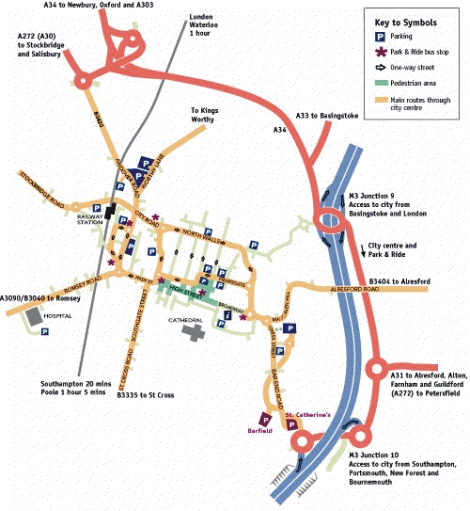
MapsFor a map of Winchester city centre, click here. For a map of Hampshire, and approaches to Winchester, click here.
|